New
Our specialist will help you choose the right server components and ensure full compatibility with your system.
Showing 16 products.
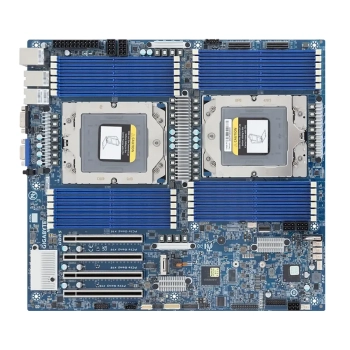
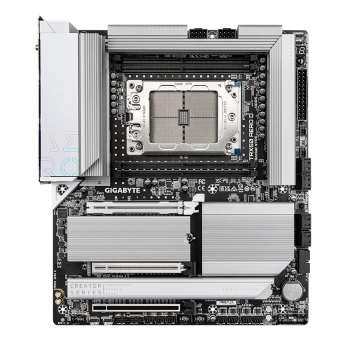
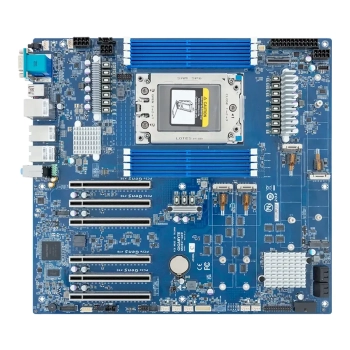
Gigabyte develops a wide range of server and workstation motherboards designed for professional computing environments where stability, compatibility, and long-term reliability are essential. In this category, you will find Gigabyte motherboards intended for enterprise servers, data-center deployments, and high-performance workstations used in business, engineering, and technical infrastructure.
Unlike consumer-oriented boards, Gigabyte server motherboards are built with a clear focus on continuous operation and predictable performance. They are commonly used in virtualization platforms, storage servers, compute nodes, and workstation systems that run under sustained load and require consistent behavior across hardware and software layers.
Gigabyte approaches server motherboard design with an emphasis on infrastructure requirements rather than short-term performance gains. These platforms are validated for server-class processors, enterprise memory configurations, and high-density I/O layouts. This makes them suitable for environments where hardware must operate reliably over long periods and integrate smoothly into standardized server architectures.
A key characteristic of Gigabyte server boards is their balance between flexibility and control. The layouts are designed to support a wide range of expansion scenarios while maintaining stable power delivery, clear airflow paths, and compatibility with common server chassis formats.
Gigabyte server motherboards are available for both major server CPU ecosystems, allowing system builders to select a platform based on workload characteristics and infrastructure strategy.
Motherboards designed for Intel Xeon processors are widely used in enterprise servers and workstation systems. These platforms support large memory capacities, multiple PCIe expansion options, and configurations suitable for virtualization, database workloads, and mixed enterprise applications.
Gigabyte boards for AMD EPYC processors are often chosen for environments that benefit from high core counts, wide memory bandwidth, and extensive PCIe connectivity. Such platforms are commonly deployed in virtualization clusters, storage systems, and modern compute infrastructure where scalability and I/O flexibility are critical.
Rather than emphasizing individual processor models, Gigabyte focuses on enabling the full capabilities of each CPU platform through stable firmware, validated component support, and consistent system behavior.
Gigabyte server motherboards are produced in standard server form factors such as ATX, E-ATX, and SSI-EEB. This allows them to be integrated into a wide range of systems, from compact workstation builds to full-depth rack-mounted servers.
Form factor selection plays an important role in system design. Larger boards provide space for additional memory slots, networking controllers, and PCIe expansion, while more compact layouts are suitable for edge deployments or workstation-style systems. Gigabyte’s portfolio covers both approaches, enabling system builders to align motherboard choice with chassis size, cooling design, and expansion requirements.
Gigabyte server motherboards are equipped with features expected in professional environments. These include support for ECC memory, enabling data integrity in critical workloads, and remote management capabilities through integrated BMC and IPMI interfaces, allowing administrators to monitor and manage systems without physical access.
Expansion support is aligned with modern server standards, offering compatibility with PCIe 4.0 and PCIe 5.0 devices depending on platform generation. This allows the use of high-speed networking adapters, NVMe storage controllers, and accelerator cards in both server and workstation configurations.
Storage connectivity is designed for enterprise scenarios, supporting combinations of NVMe, SATA, and SAS devices depending on the board and chipset. This flexibility makes Gigabyte motherboards suitable for compute-focused servers as well as storage-oriented systems.
Gigabyte workstation motherboards are commonly used in systems for CAD, simulation, content creation, and technical computing, where stable drivers, memory capacity, and expansion options are important. These platforms bridge the gap between desktop performance and server-grade reliability.
In server environments, Gigabyte motherboards are deployed as part of virtualization hosts, storage nodes, and application servers. Their design supports multi-user workloads, continuous operation, and integration into managed infrastructure.
Selecting a Gigabyte server or workstation motherboard begins with defining the intended workload and deployment environment. CPU platform compatibility is the primary factor, followed by memory requirements, expansion needs, and chassis constraints.
For example, virtualization platforms may prioritize memory capacity and network connectivity, while compute or GPU-focused systems require sufficient PCIe lanes and appropriate slot placement. Gigabyte’s broad product range allows system builders to select boards that match specific technical requirements rather than adapting general-purpose solutions.
ATX boards are typically used in compact servers and workstation systems where space efficiency is important. E-ATX motherboards offer additional physical space for more memory slots, expansion cards, and onboard controllers, making them suitable for larger server configurations.
SSI-EEB is an enterprise server form factor defined by the Server System Infrastructure standard. It is commonly used in dual-socket servers and platforms that require high memory capacity, multiple PCIe slots, and stable power delivery for continuous workloads.
Larger form factors allow more PCIe slots, additional networking controllers, and higher memory density. This is especially important for GPU servers, virtualization hosts, and storage systems that rely on multiple expansion devices.
Yes. Gigabyte server motherboards follow industry-standard mounting points and dimensions, making them compatible with most rack-mount server chassis that support the corresponding form factor.
ATX Gigabyte server and workstation boards are commonly used in professional workstations where enterprise features such as ECC memory and remote management are required, but a full rack-mount system is not necessary.
They are designed specifically for sustained workloads and continuous operation. Power delivery, thermal layout, and component validation are aligned with enterprise deployment requirements.
Yes. Many models support multiple PCIe slots and are designed to accommodate accelerator cards, making them suitable for GPU computing, AI workloads, and visualization servers.