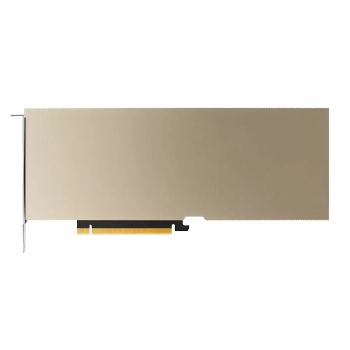
New
Our specialist will help you choose the right server components and ensure full compatibility with your system.
Showing 30 products.
P/N: 900-5G153-2200-000
7 078€ (excl. TAX)
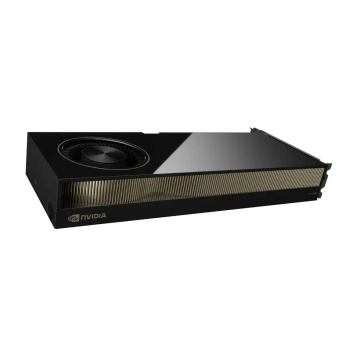
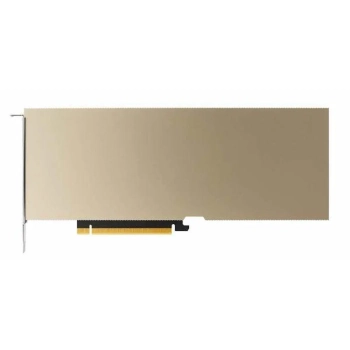
P/N: 900-5G144-2200-000
7 579€ (excl. TAX)
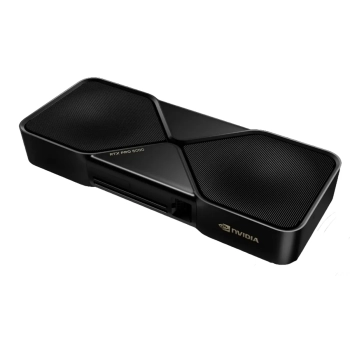
P/N: 900-2G153-0000-000
7 702€ (excl. TAX)
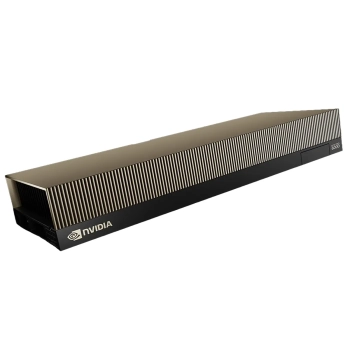
NVIDIA has become one of the most widely used platforms for professional graphics and compute workloads. Its GPUs serve not only as rendering processors, but as general-purpose accelerators for AI training, inference, large-scale simulations, scientific modelling, and virtualized environments. This category covers workstation-class cards and data-center modules used in servers, cloud clusters, engineering workstations, and enterprise pipelines.
Modern NVIDIA architectures evolve in parallel with the needs of professional compute. Ampere brought high memory bandwidth, MIG virtualization, and mature enterprise acceleration. Ada delivers high efficiency and advanced visualization tools for workstation workloads. Hopper introduced new levels of AI performance through the Transformer Engine and fast interconnects. The most recent Blackwell generation expands this capability further with HBM3e memory, new compute formats, and multi-die designs intended for very large AI models and HPC clusters. Each architecture serves its own segment, giving buyers several clear paths depending on their workflow.
NVIDIA workstation GPUs are widely used in engineering, design, simulation, architecture, and real-time visualization. The RTX Ada family combines high core counts with efficient GDDR6 memory and enhanced ray-tracing capabilities, making it suitable for CAD applications, digital content creation, and VFX production.
The professional A-series cards offer stability, ECC options, optimized thermals, and certified drivers, making them reliable tools for studios and technical teams who require predictable performance and compatibility with industry software.
Data-center GPUs are built for sustained workloads: training AI models, processing scientific simulations, powering virtual desktops, or running multi-tenant cloud environments.
The A-series provides strong mixed-precision compute, HBM2e memory, and consistent performance for both training and inference. Hopper GPUs are designed for large model training and offer high throughput boosted by advanced compute units and fast interconnects. L-series accelerators focus on efficient inference and visualization tasks in servers or cloud instances. Blackwell, the latest generation, extends scalability and memory bandwidth for enterprise AI systems, giving organizations more room for large datasets and sophisticated workloads.
These families support PCIe and SXM formats, multi-GPU scaling through NVLink, and a wide range of memory configurations — all critical components in high-density systems.
NVIDIA GPUs are used across industries where compute density matters. In AI development, they accelerate transformer models, training pipelines, and inference services with consistent performance. In engineering, they support simulation workflows such as CFD, structural analysis, and digital twins. Rendering teams benefit from faster previews, complex lighting calculations, and reliable multi-GPU output.
Organizations deploying VDI or cloud platforms rely on NVIDIA’s virtualization stack, using GPUs to power multiple users and intensive graphical applications from a single server. This ecosystem remains flexible, allowing teams to scale from a single workstation to full GPU clusters.
Selecting the correct GPU depends on several factors, including the type of memory required (GDDR6, HBM2e, HBM3, HBM3e), the need for high compute precision, multi-GPU scaling demands, cooling constraints, and the expected workload profile. Workstations usually benefit from RTX Ada or A-series cards due to their efficiency and ISV certifications. Data-center workloads that rely on matrix compute or AI pipelines often require GPUs with HBM memory and advanced interconnect options. Balancing these aspects ensures long-term performance and compatibility with existing software environments.
Workstation GPUs are optimized for design, engineering, and visualization. Data-center GPUs focus on compute density, memory bandwidth, and multi-GPU scaling for AI and HPC.
High-bandwidth models such as A100, H100, or Blackwell-based GPUs are typically used for training large models.
Many enterprise models do, especially those in the A-series and higher-end workstation cards.
HBM offers far higher bandwidth than traditional GDDR memory, which is essential for scientific computing and AI workloads with high data transfer rates.
Not always, but it greatly improves communication between GPUs in training, simulation, and HPC tasks.
Yes. They provide high efficiency, strong performance per watt, and broad compatibility with engineering and design applications.