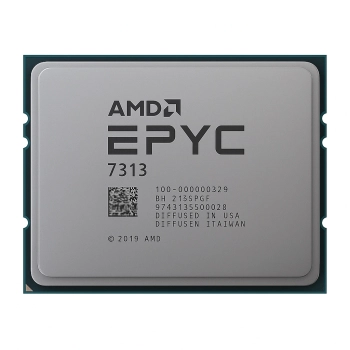
AMD EPYC 7313 16c/32t 3.0GHz-3.7GHz 155W (100-000000329)
P/N: 100-000000329
686€ (inc. VAT (Spain))
New
P/N: 100-000001284
894€ (inc. VAT (Spain))
Delivery is made within 3-7 days
This is an estimated timeframe. Delivery times may vary depending on logistics and stock availability.
Warranty 2 year
The product is covered by the manufacturer’s standard warranty.
In stock
Guaranteed Safe Checkout:

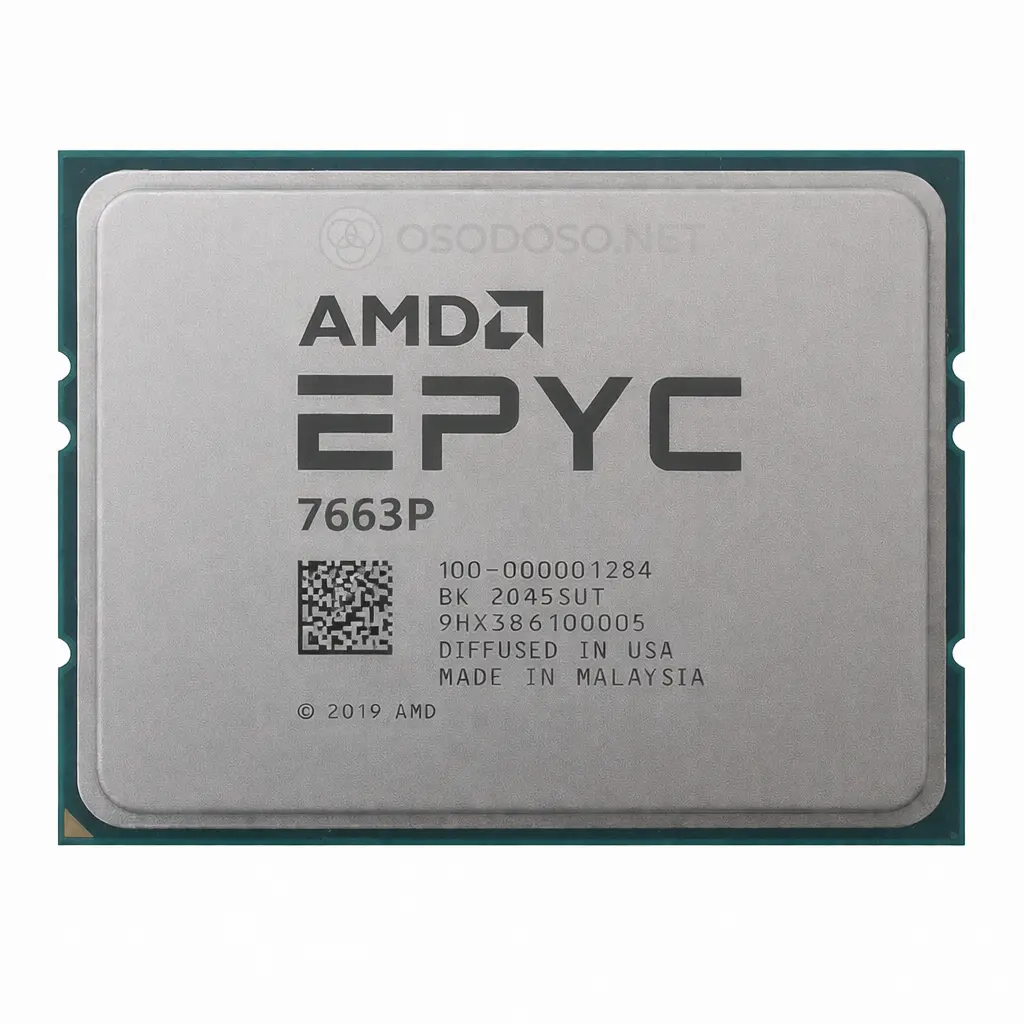
AMD EPYC 7663P 56-core single-socket server CPU for cost-efficient high-density deployments. Official warranty included.
Our specialist will help you choose the right server components and ensure full compatibility with your system.
| Country of manufacture | Taiwan |
|---|---|
| Manufacturer's warranty (years) | 1 |
| Series | EPYC |
| Number of cores | 56 |
| Number of threads | 112 |
| Clock frequency (GHz) | 2.0 |
| Cache L3 (MB) | 256 |
| Process technology (nm) | 7 |
| Maximum Turbo Frequency (GHz) | 3.5 |
| Memory type | DDR4 |
| Maximum memory channels | 8 |
| Maximum memory frequency (MHz) | 3200 |
| Heat dissipation TDP (W) | 240 |
| PCI Express controller | PCIE 4.0 |
| Number of PCI Express lanes | 128 |
| Processors on a motherboard | 1 |
| Architecture | Zen 3 (Milan) |
| Socket | SP3 |
AMD EPYC 7663P is a 3rd Gen EPYC “Milan” processor optimized specifically for single-socket server platforms. The “P” designation indicates a focus on cost-efficient deployments where one socket must deliver maximum parallel compute, memory bandwidth, and I/O capacity without relying on a second CPU. Within the EPYC 7003 family, the 7663P targets high-density enterprise and cloud environments that standardize on powerful 1P nodes to reduce platform complexity and licensing costs.
The processor offers 56 cores and 112 threads, operating at a 2.0 GHz base frequency with boost clocks up to 3.5 GHz. This configuration prioritizes sustained multi-threaded throughput over peak single-core speed. In practice, EPYC 7663P excels in workloads that maintain high utilization across many threads, such as large virtualization hosts, container platforms with hundreds of services, and distributed compute frameworks.
Because the processor is designed for single-socket operation, all available cores, memory channels, and I/O lanes are concentrated in one NUMA domain. This simplifies resource scheduling and can reduce latency variability compared to dual-socket systems when workloads are properly tuned.
EPYC 7663P includes 256 MB of shared L3 cache, which provides a balanced cache-to-core ratio for throughput-oriented workloads. While it does not feature the expanded cache of X-series models, this cache capacity is sufficient for most enterprise services where working sets are large but primarily benefit from memory bandwidth and parallel execution rather than extreme cache residency.
In virtualized environments, the shared L3 cache helps smooth performance when many guests are active simultaneously, reducing cache contention and improving consistency under peak load.
The processor supports DDR4-3200 memory across 8 memory channels, even in a single-socket configuration. This is a key advantage of EPYC P-series CPUs: a 1P system still provides full EPYC memory bandwidth, allowing high VM density and memory-intensive workloads without the need for a second socket.
Proper memory population is critical to realizing this benefit. Balanced DIMM placement across all channels ensures maximum bandwidth and avoids artificial bottlenecks that can limit throughput long before CPU resources are exhausted.
EPYC 7663P supports PCI Express 4.0 with up to 128 lanes available to a single socket. This enables dense NVMe storage configurations, high-speed networking, and accelerator connectivity without PCIe switches or additional controllers. For infrastructure teams, this simplifies server design and improves reliability by reducing platform complexity.
The processor uses the SP3 socket and is limited to single-socket systems by design. This restriction allows AMD to offer aggressive pricing and power efficiency for environments that do not require dual-socket scalability. In many modern cloud and enterprise architectures, scaling out with more 1P nodes provides better flexibility and fault isolation than scaling up with fewer dual-socket servers.
EPYC 7663P has a 240 W TDP, which is typical for high-core-count EPYC processors. Adequate server-grade cooling and airflow are required to maintain stable operation under sustained load. In properly engineered platforms, the processor delivers consistent throughput and predictable performance for always-on production environments.
EPYC 7663P is best suited for organizations building high-density single-socket servers. Typical use cases include virtualization hosts with large VM populations, container orchestration nodes with high concurrency, cloud infrastructure optimized for scale-out design, and enterprise back-end services focused on throughput. For workloads that require dual-socket scalability or benefit from higher per-core frequency, other EPYC models may be more appropriate. EPYC 7663P is most effective when the goal is to maximize parallel throughput and memory bandwidth per socket while keeping system design simple and cost-efficient.
Only logged in customers who have purchased this product may leave a review.
Fast and reliable delivery across the European Union
Estimated transit time: 3–7 days from order confirmation. Worldwide shipping is available for customers outside the EU.
All orders are processed within 24 hours after confirmation. Tracking information is provided as soon as the parcel leaves our logistics center.
Multiple Secure Payment Methods
We accept: Visa, MasterCard, PayPal, Bank Transfer, Klarna, Stripe, Revolut Pay, Google Pay, Apple Pay, and USDT (TRC20) cryptocurrency payments.
All transactions are encrypted and processed via certified payment gateways for your security.
Additional Notes
P/N: 100-000000329
686€ (inc. VAT (Spain))
P/N: 100-000000345
860€ (inc. VAT (Spain))
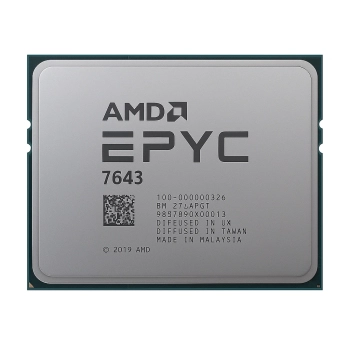
P/N: 100-000000326
1 335€ (inc. VAT (Spain))
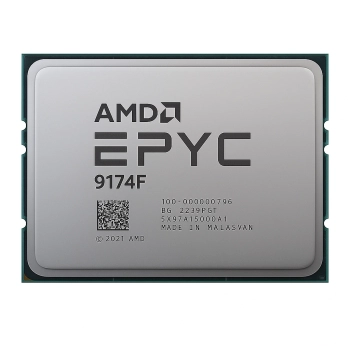
P/N: 100-000000796
2 341€ (inc. VAT (Spain))
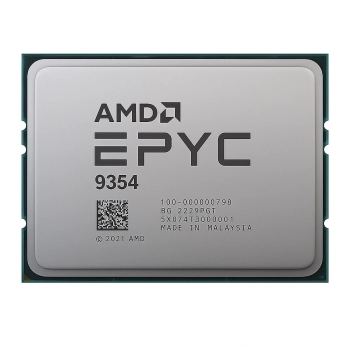
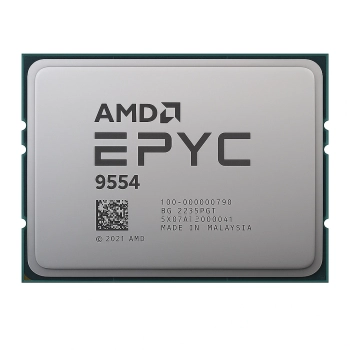
P/N: 100-000000798
1 937€ (inc. VAT (Spain))
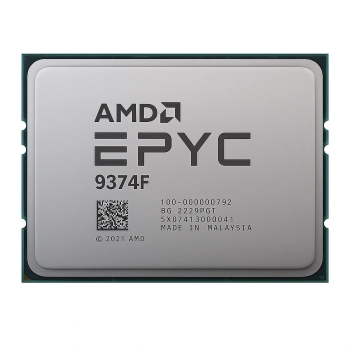
P/N: 100-000000792
2 863€ (inc. VAT (Spain))
P/N: 100-000000790
3 790€ (inc. VAT (Spain))
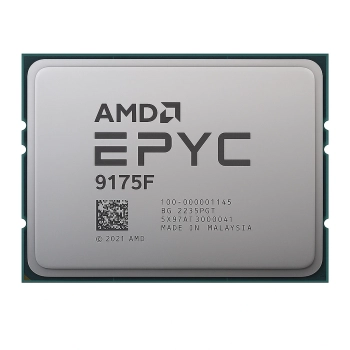
P/N: 100-000001145
3 674€ (inc. VAT (Spain))
Reviews
There are no reviews yet.