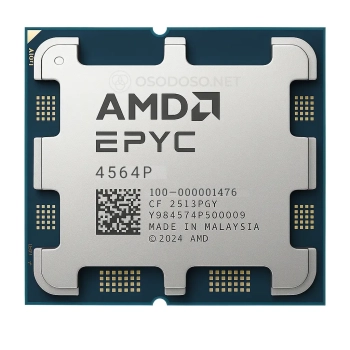
AMD EPYC 4564P 16c/32t 4.5GHz-5.7GHz 170W (100-000001476)
P/N: 100-000001476
813€ (inc. VAT (Spain))
New
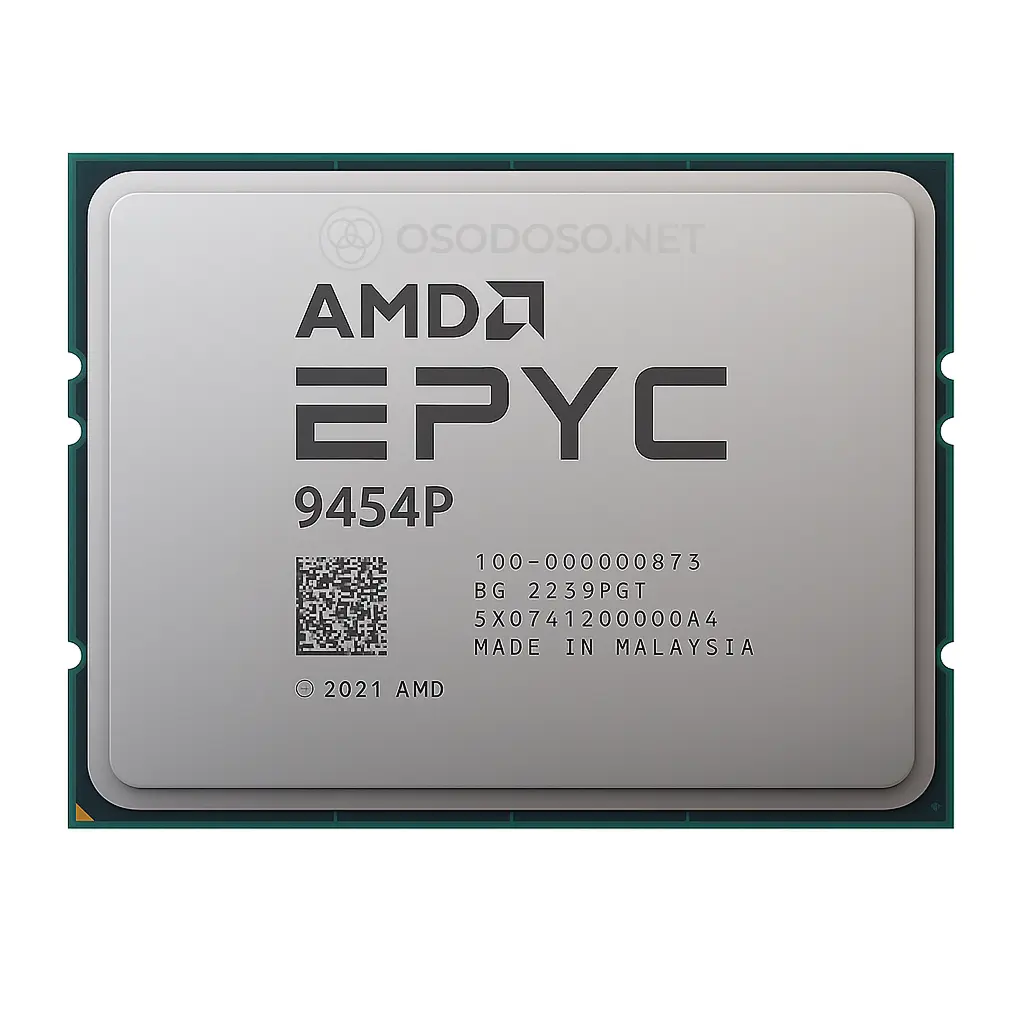
P/N: 100-000000873
2 110€ (inc. VAT (Spain))
Delivery is made within 3-7 days
This is an estimated timeframe. Delivery times may vary depending on logistics and stock availability.
Warranty 2 year
The product is covered by the manufacturer’s standard warranty.
In stock
Guaranteed Safe Checkout:

AMD EPYC 9454P 48-core single-socket CPU with fast EU delivery and worldwide shipping. Official warranty included.
Our specialist will help you choose the right server components and ensure full compatibility with your system.
| Dimensions | 17 × 17 × 10 cm |
|---|---|
| Country of manufacture | Taiwan |
| Manufacturer's warranty (years) | 1 |
| Series | EPYC |
| Number of cores | 48 |
| Number of threads | 96 |
| Clock frequency (GHz) | 2.75 |
| Cache L3 (MB) | 256 |
| Cache L2 (MB) | 1 |
| Process technology (nm) | 5 |
| Maximum Turbo Frequency (GHz) | 3.8 |
| Memory type | DDR5 |
| Maximum memory channels | 12 |
| Maximum memory frequency (MHz) | 4800 |
| Heat dissipation TDP (W) | 290 |
| PCI Express controller | PCIE 5.0 |
| Number of PCI Express lanes | 128 |
| Processors on a motherboard | 1 |
| Length (cm) | 17 |
| Width (cm) | 17 |
| Architecture | Zen 4 |
| Socket | SP5 |
The AMD EPYC 9454P represents a pivotal point in the evolution of single-socket server computing. While the broader Genoa lineup introduces architectural improvements across the board, this model is particularly significant because it demonstrates how far the industry has moved toward eliminating the traditional dependency on dual-socket platforms for high-density compute workloads. With 48 Zen 4 cores, 96 threads and a 256 MB unified L3 cache, it delivers computing power that only a few years ago required two CPUs and a more complex, costlier platform.
The defining characteristic of the 9454P is not simply its core count, but the consistency with which it sustains performance across diverse workloads. Zen 4’s microarchitectural changes, including widened execution engines, improved branch prediction accuracy and reduced front-end stalls, give this processor strong per-core efficiency. These characteristics matter greatly in datacenter environments where unpredictable workload patterns can disrupt latency-sensitive applications. Independent cloud performance evaluations have highlighted that Genoa processors maintain more stable tail latency compared to previous generations, especially under mixed IO and compute pressure. This directly benefits virtualization clusters and microservice-heavy architectures, where “noisy neighbor” effects are a recurring challenge.
Another critical factor in the real-world value of the EPYC 9454P lies in its memory subsystem. The move to a 12-channel DDR5 interface dramatically increases available bandwidth, which fundamentally impacts performance in software stacks that rely on heavy memory parallelism. Database engines such as PostgreSQL and MySQL have shown notable throughput improvements on Genoa-based nodes, not due to raw CPU frequency but thanks to the ability to sustain large volumes of parallel memory operations. Similarly, distributed indexing engines, in-memory analytics systems and preprocessing layers in ML pipelines benefit from the increased bandwidth headroom, which helps maintain predictable performance even when the working dataset outgrows last-level cache.
The I/O capabilities of the 9454P reinforce this scalability. A full set of 128 PCIe 5.0 lanes ensures that storage backends and accelerators operate without contention. In practice, this means NVMe arrays can run at line rate even when the same node hosts high-throughput network adapters or AI accelerators. Several enterprise storage vendors have already shifted their primary controller designs to single-socket SP5 systems because the available PCIe bandwidth eliminates the need for additional CPUs solely for I/O distribution. This architectural shift simplifies cooling, improves power density and reduces long-term maintenance overhead.
From an infrastructure planning perspective, the 9454P has become particularly appealing for operators focused on horizontally scalable designs. Many organizations are now adopting architectures where growth is achieved through more nodes rather than more powerful dual-socket systems. In such environments, uniform 1P servers offer advantageous characteristics: lower per-node power consumption, simpler failure domains and improved cluster elasticity. With a 290 W TDP, the 9454P fits comfortably into dense 1U and 2U chassis without requiring aggressive cooling designs, allowing datacenters to maintain stable rack-level thermal envelopes.
Comparing the 9454P to adjacent Genoa models further clarifies its positioning. Systems based on the 9354 offer good efficiency but lack the additional compute density that many virtualization and analytics workloads now demand. The non-P 9454 introduces multi-socket flexibility but at a cost premium that does not translate into practical advantages for operators committed to single-socket clusters. Higher-core models like the 9554 or 9654 provide superior throughput but require higher capital investment, increased cooling capacity and may bring software licensing implications that outweigh the benefit for many enterprise scenarios.
This is ultimately where the 9454P stands out: it manages to deliver a level of computational density previously associated with much more complex systems while preserving the operational simplicity of a 1P architecture. Its performance-per-watt profile, especially under sustained load, has made it a favored choice in environments where predictable 24/7 performance is essential—managed hosting platforms, search clusters operating under heavy indexing loads and data processing pipelines with prolonged CPU-bound stages.
In summary, the AMD EPYC 9454P is not simply a mid-range Genoa part; it is one of the most strategically relevant CPUs in the current server market. It embodies the transition to high-performance single-socket designs and provides a balance of compute density, memory bandwidth and PCIe resources that aligns with the architectural direction many enterprises are already taking. For organizations building scalable virtualized infrastructure, modern analytics pipelines or high-throughput application backends, the 9454P offers a combination of capability and efficiency that is difficult to match within the same power and cost envelope.
Only logged in customers who have purchased this product may leave a review.
Fast and reliable delivery across the European Union
Estimated transit time: 3–7 days from order confirmation. Worldwide shipping is available for customers outside the EU.
All orders are processed within 24 hours after confirmation. Tracking information is provided as soon as the parcel leaves our logistics center.
Multiple Secure Payment Methods
We accept: Visa, MasterCard, PayPal, Bank Transfer, Klarna, Stripe, Revolut Pay, Google Pay, Apple Pay, and USDT (TRC20) cryptocurrency payments.
All transactions are encrypted and processed via certified payment gateways for your security.
Additional Notes
P/N: 100-000001476
813€ (inc. VAT (Spain))
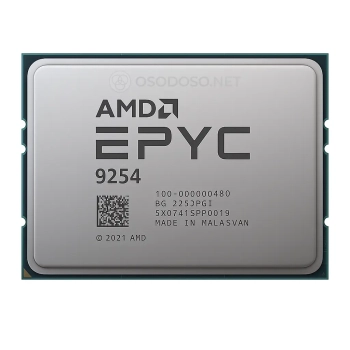
P/N: 100-000000480
1 705€ (inc. VAT (Spain))
P/N: 100-000000478
2 168€ (inc. VAT (Spain))
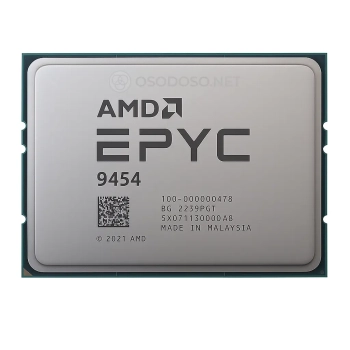
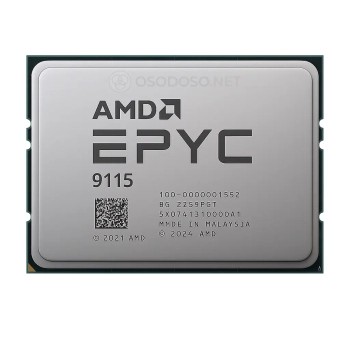
P/N: 100-000001552
1 091€ (inc. VAT (Spain))
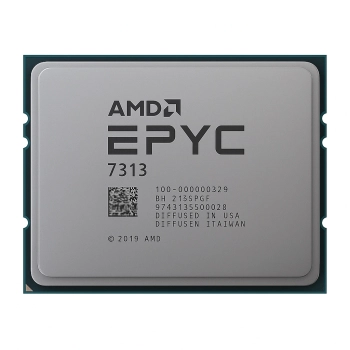
P/N: 100-000000329
686€ (inc. VAT (Spain))
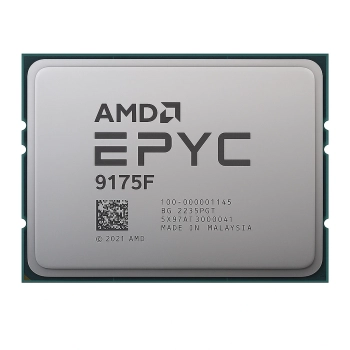
P/N: 100-000001145
3 674€ (inc. VAT (Spain))
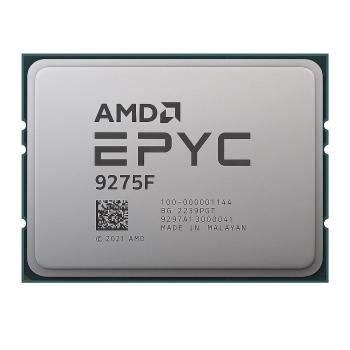
P/N: 100-000001144
3 615€ (inc. VAT (Spain))
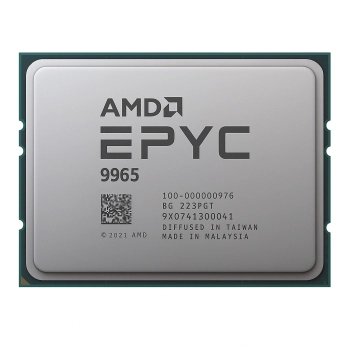
P/N: 100-000000976
5 931€ (inc. VAT (Spain))
Reviews
There are no reviews yet.